

Choosing a proprietary trading firm is not simply a matter of finding the largest advertised account or the highest profit split. Two companies can offer similar simulated account sizes while applying very different evaluation targets, drawdown calculations, consistency requirements, trading restrictions, and payout conditions.
These differences become especially important when a trader is deciding between a one-step evaluation, a multi-stage challenge, or a futures-focused program. A rule that seems minor on a firm’s marketing page can have a substantial effect on whether a particular trading strategy fits the account.
This guide compares five prop trading companies through the practical details traders should investigate before paying for a challenge. The focus is on understanding program rules, identifying the differences between account models, and deciding which type of firm is worth researching further.
What Separates One Prop Firm From Another?
Before comparing individual companies, it helps to understand the rules that influence the evaluation process.
Evaluation structure
A one-step challenge generally requires a trader to meet the evaluation objectives in one phase. A two-step challenge introduces another phase, usually with its own profit target and requirements. Three-step programs divide the process further.
Fewer stages do not automatically mean an easier challenge. A one-step program may have tighter drawdown limits or additional consistency requirements, while a multi-step program may provide more time to demonstrate a repeatable approach.
Daily and maximum drawdown
Daily drawdown limits losses within a defined trading day. Maximum drawdown restricts cumulative losses over a longer period. The calculation method matters just as much as the percentage.
A static maximum-loss limit stays tied to a defined starting balance. A trailing limit can move upward as the account reaches new highs. Traders should also establish whether the firm includes floating losses, commissions, and swaps in its calculations.
Time limits and minimum trading days
Some programs allow traders to work toward a target without a maximum evaluation duration, while others impose minimum trading-day requirements or additional qualifying conditions.
A minimum-day requirement is not the same as a deadline. Traders should understand both before selecting a challenge, particularly if their strategy generates relatively few setups.
Payout eligibility
Passing an evaluation does not necessarily mean that a reward can be requested immediately. Funded-stage rules may include minimum trading days, consistency requirements, withdrawal schedules, account buffers, or other eligibility conditions.
The advertised profit split should therefore be considered alongside the complete payout policy.
Five Prop Trading Companies Compared
The following comparison uses a beginner-oriented format. The scores are editorial assessments for this article, not official ratings issued by the companies. Time limits and refund policies are program-specific, so details that cannot safely be generalized are marked for verification rather than assumed to apply to every account.
| Prop Firm | Why Beginners May Like It | Time Limit | Free Retry / Refund | Editorial Score |
|---|---|---|---|---|
| FTMO | Established evaluation structure with clearly defined objectives | No maximum evaluation duration for the standard challenge, subject to current terms | Depends on the challenge and fee policy; verify before purchase | 9.2/10 |
| FundedNext | Multiple challenge models for different trading preferences | Depends on the selected program | Program-specific; check the current refund and retry conditions | 8.8/10 |
| Topstep | Futures-focused structure for traders learning contract-based risk management | Subscription and evaluation conditions apply; check the chosen Trading Combine | Depends on the selected payment path and current terms | 8.6/10 |
| Leofins | Three evaluation formats, static maximum-loss limits, and multiple asset classes | No maximum phase duration under its published evaluation rules | Fee reward depends on the selected program; check current conditions | 8.5/10 |
| The5ers | Structured evaluation paths and several program options | Depends on the selected program | Varies by program and purchase terms | 8.4/10 |
Scoring methodology: The scores reflect the perceived usefulness of each firm’s program structure for traders comparing rules, flexibility, and account requirements. They do not measure payout reliability, guarantee a successful evaluation, or imply that one firm is suitable for every trader. Confirm all current conditions before purchasing.
#1 — FTMO: A Structured Approach to Evaluation
FTMO is a well-known prop trading firm offering one-step and two-step evaluation options. The standard two-step FTMO Challenge separates the evaluation into the Challenge and Verification stages, each with its own profit objective and trading requirements.
For the standard two-step model, the published rules include a 10% profit target in the first phase and 5% in Verification. The maximum daily loss is 5%, while the maximum loss is 10% of the initial account balance. These figures describe that particular model and should not be transferred automatically to the one-step challenge, which has different loss rules.
The main advantage for a trader comparing programs is the opportunity to examine a defined set of objectives before committing to an evaluation. It is still important to understand how the firm calculates equity, when daily loss limits reset, and what restrictions apply to the chosen account.
FTMO may suit traders who prefer a structured process and want to assess their performance against explicit targets. However, beginners should not confuse familiarity with the brand for evidence that a challenge will be easy. The account’s drawdown rules and the trader’s own risk management remain decisive.
Before paying, review the current challenge conditions, platform availability, any applicable consistency requirements, and the rules governing rewards after the evaluation.
#2 — FundedNext: Multiple Models for Different Trading Styles
FundedNext offers several challenge models, including CFD-focused programs with different evaluation structures. This allows traders to compare one-step and multi-step approaches instead of assuming that one format works for everyone.
Its Stellar 2-Step program, for example, has published profit targets of 8% in the first phase and 5% in the second. The stated daily loss limit is 5%, with a 10% static maximum-loss limit. The Stellar 1-Step and Stellar Lite programs use different thresholds, so it is important to compare the exact account rather than rely on a single company-wide figure.
For beginners, the variety of account types can be useful when comparing evaluation objectives. But more options can also make the selection process confusing. Each model needs to be reviewed for its own drawdown calculation, minimum trading-day requirements, platform restrictions, and reward conditions.
FundedNext may be worth researching if you want a CFD program with several challenge formats. Before purchasing, verify the complete fee policy and whether any advertised refund, reward, or retry benefit is cash-based, conditional, or restricted to a particular program.
#3 — Topstep: A Futures-First Alternative
Topstep differs from firms primarily associated with forex and CFD challenges because its Trading Combine is focused on futures. Traders work with exchange-traded futures contracts in a simulated evaluation environment and must meet the program’s objectives while respecting its risk rules.
Futures require a different approach to position sizing. Traders need to understand contract multipliers, tick sizes, tick values, and the monetary impact of price movements. A strategy that uses lots on a forex CFD platform cannot simply be transferred to futures without recalculating risk.
Topstep’s evaluation structure includes a profit target, a maximum loss limit, and a consistency objective. The maximum loss calculation is particularly important because its behavior differs from a simple static percentage-based loss floor. Traders should also check the daily trading cutoff and any requirements to close positions before the end of the session.
For beginners who specifically want to learn futures trading, Topstep offers a focused environment rather than a broad multi-asset CFD account. That focus can be helpful when the trader understands the relevant contracts and has a strategy suited to futures sessions.
The payment structure also deserves attention. Subscription options and activation conditions can affect the total cost of an evaluation, so compare the complete cost rather than just the first advertised payment.
#4 — Leofins: Three Evaluation Formats and Multiple Markets
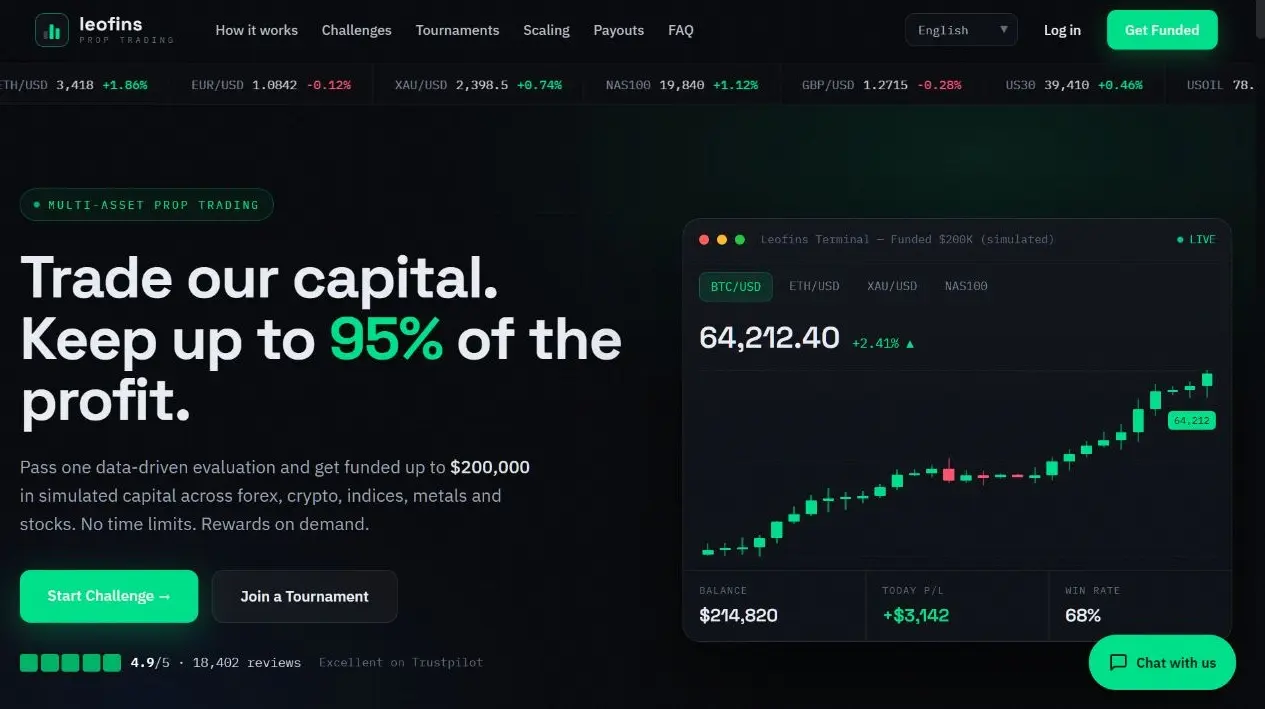 Leofins is worth considering for traders who want to compare different evaluation structures while retaining access to several asset classes. Its published offerings include the Core 2-Step, Edge 1-Step, and Starter 3-Step programs, allowing traders to examine different combinations of evaluation stages and loss limits.
The Core 2-Step program has a published combined profit target of 11%, divided into 7% in the first phase and 4% in the second. It lists a 5% daily loss limit and a 10% static maximum-loss limit. Edge 1-Step has an 8% target, a 4% daily loss limit, and a 7% static maximum-loss limit. Starter 3-Step lists a combined 14% target across three phases, with a 4% daily loss limit and an 8% static maximum-loss limit.
These differences illustrate why choosing a program matters more than choosing a firm name alone. The one-step route has fewer evaluation stages but a different overall loss allowance, while the two-step and three-step formats distribute the evaluation objectives across more phases.
Leofins states that its evaluation phases and funded accounts operate in simulated environments. Its published rules also specify no maximum duration for evaluation phases, with at least two separate trading days required per phase. News trading and weekend holding are permitted within the stated risk restrictions, and personal Expert Advisors are allowed subject to the firm’s rules.
The company lists more than 300 instruments across forex, crypto, indices, metals, energies, and shares in its CFD offering. It also offers a separate futures-focused program, so traders should be careful not to confuse the instrument lists or rules of the two products.
The firm’s official website, leofins.com, provides details of its challenge formats and current conditions. Before making a decision, review the applicable maximum-loss rule, the daily loss calculation, minimum trading days, payout schedule, and fee-reward policy for your selected account.
Leofins may suit traders who value the ability to compare several evaluation formats and want access to multiple markets. The key is to select the format that matches your strategy and risk tolerance rather than assuming that fewer stages or a larger account will produce a better outcome.
#5 — The5ers: Different Programs for Different Needs
The5ers offers several structured prop trading programs, with conditions that vary by product. Traders should therefore evaluate the individual program rather than assuming that every account follows the same rules.
Its High Stakes program is a two-step evaluation. Published rules have included profit targets of 10% in the first phase and 5% in the second, alongside a daily loss limit and a static maximum-loss threshold. Other The5ers offerings, including Bootcamp and futures-focused options, have different structures and requirements.
This range may appeal to traders who want to compare evaluation paths with different entry conditions. However, it also makes careful reading essential. A trader considering High Stakes should not apply those thresholds to a Bootcamp or futures account without checking the relevant rulebook.
The5ers is worth researching if you prefer a structured challenge and want to compare the evaluation objectives before paying. Review the exact daily-loss calculation, minimum profitable days, permitted trading behavior, holding rules, and payout requirements.
How to Choose the Right Program
Start with your trading market
If you trade forex and CFDs, look for a program whose instruments and platform support your existing strategy. If you trade futures, prioritize contract availability, tick values, session rules, and the way maximum loss is calculated.
Switching markets simply because a prop firm advertises a large account can introduce unnecessary complexity.
Compare the actual loss allowance
A headline drawdown percentage is not enough. Determine whether the limit is static or trailing, whether it is based on balance or equity, and whether open-position losses and trading costs count toward the threshold.
Calculate the monetary loss allowance for the account size you intend to purchase. This makes it easier to judge whether the program fits your normal position sizing.
Check the full evaluation process
Compare profit targets, minimum trading days, consistency conditions, and time limits. A one-step challenge may be convenient, but it can have a different risk allowance from a two-step alternative.
Also check what happens after a breach. A failed evaluation, a temporary trading pause, and a reset option are different outcomes.
Understand fees and rewards
Challenge fees, subscriptions, activation costs, and reset payments can materially change the total expense. Reward eligibility can also depend on conditions that are separate from the headline profit split.
Never assume that a fee is refundable or a retry is free unless the terms for the exact program explicitly say so.
Common Mistakes When Comparing Prop Firms
One common mistake is choosing the largest advertised account without checking the maximum-loss allowance. A larger simulated balance is not automatically easier to manage, especially if the drawdown rules are restrictive.
Another is comparing percentages from different challenge types as though they were identical. A firm’s one-step model may have a different daily limit and maximum-loss calculation from its two-step model.
Traders also sometimes overlook payment structures. A low initial fee may be followed by a subscription or activation cost, while another program may charge a one-time fee with different conditions.
Finally, do not treat a successful evaluation as guaranteed income. Passing a challenge depends on performance under the rules, and funded-stage rewards remain subject to the provider’s agreement and eligibility conditions.
Frequently Asked Questions
What is a prop firm?
A proprietary trading firm offers a program through which traders demonstrate their ability to trade within defined rules. Many retail prop firms use simulated evaluation and funded-account environments, with eligible rewards determined by the firm’s agreement and the trader’s performance.
Which prop firm should a beginner start with?
Start with a program whose rules are easy to understand and whose trading environment matches your experience. FTMO, FundedNext, Topstep, Leofins, and The5ers have different structures, so compare the exact account type, challenge fee, drawdown limits, and trading instruments before deciding.
Is the money in a prop firm’s account real?
In many retail prop programs, the displayed account balance is simulated rather than cash owned by the trader. Eligible rewards or payouts are determined by the firm’s agreement and the trader’s performance under its rules. The advertised account size should not be confused with a personal cash balance or guaranteed income.
Is a one-step challenge better than a two-step challenge?
Not automatically. A one-step challenge may have fewer evaluation stages, but its drawdown allowance or other requirements can be different. Compare the full rule set rather than choosing solely by the number of phases.
What is the difference between static and trailing drawdown?
A static maximum-loss threshold remains tied to a defined starting balance. A trailing threshold can move as the account reaches new highs, depending on the firm’s calculation method. This can change the available loss buffer after profitable periods.
Can I use automated trading with a prop firm?
Some firms permit personal Expert Advisors or other automation, while others restrict particular methods. Always check the rules for the exact program, including any limitations on trade copying, third-party signals, latency arbitrage, or automated execution.
Should I choose a firm based on its profit split?
The profit split matters, but it should not be the only deciding factor. Evaluation rules, drawdown, total costs, payout conditions, platform availability, and the permitted trading strategy can be equally important.
The Best Choice Depends on the Rules You Can Follow
FTMO, FundedNext, Topstep, Leofins, and The5ers represent different approaches to proprietary trading evaluations. FTMO and FundedNext offer CFD-oriented challenge models, Topstep focuses on futures, and The5ers provides multiple program types. Leofins offers several evaluation formats and both CFD and futures routes.
The most useful comparison is not simply which company has the highest editorial score. It is which program has rules compatible with your strategy, risk tolerance, available time, and budget. Review the exact challenge conditions, calculate the loss allowance, and understand the payout requirements before paying a fee.
A clear understanding of the rules cannot guarantee that an evaluation will be successful, but it can help you avoid selecting a program that conflicts with the way you trade.
Prices and conditions are current as of October 2026.
Risk disclaimer: Proprietary trading evaluations involve financial risk. Challenge fees may be lost if an evaluation is unsuccessful or program rules are breached. Simulated trading and funded-program results do not guarantee future performance or income. Review the current terms carefully and never spend money you cannot afford to lose.